

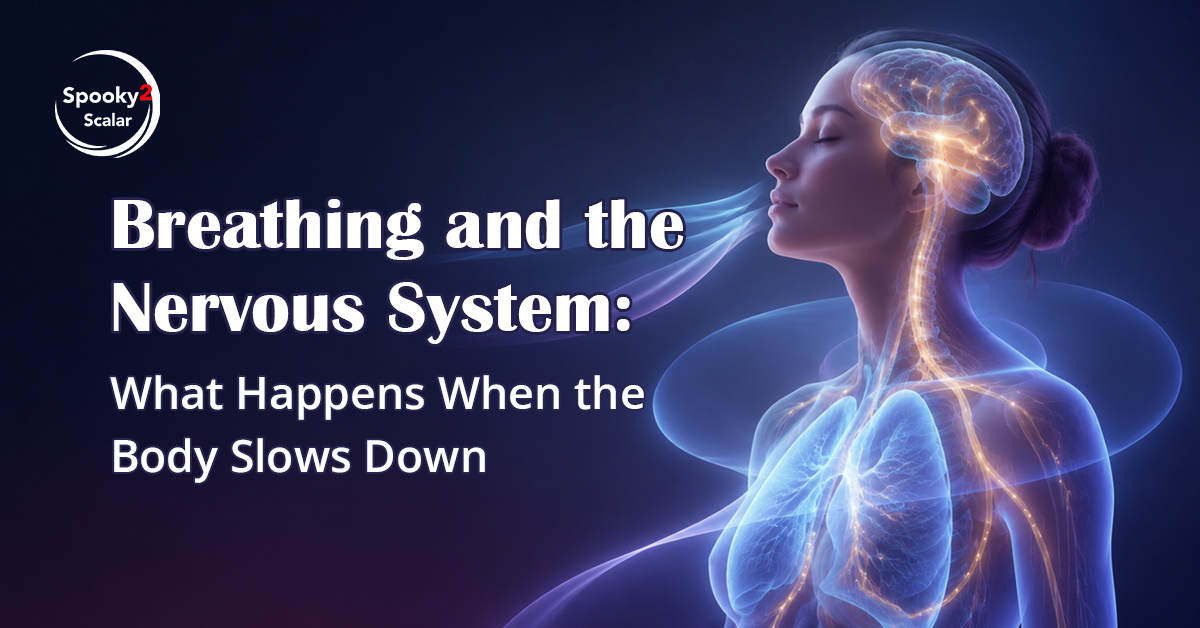
Have you ever noticed that you hold your breath when you're tense? Or that after a long, busy day, your breathing has become shallow and quick without you realizing it?
Breath happens just below awareness. We do it all day, every day, but we rarely pay attention to how we're breathing. And yet, breath sits right between the voluntary and the automatic. You can choose to take a slow breath. But you don't have to remember to breathe while you sleep.
That makes breath a simple doorway into the nervous system — and a gentle way to help your body shift out of "doing" mode and into "resting" mode.
How Breath Talks to the Nervous System
Your breathing is regulated by the brainstem, but it's also influenced by signals from the rest of your body. When you're stressed, breathing tends to become faster and shallower. When you're relaxed, it naturally slows down. This isn't a coincidence — it's a two-way street.
The autonomic nervous system has two main branches:
Mobilizes energy for action — often called "fight or flight."
Supports rest, digestion, and recovery — "rest and digest."
Slow, rhythmic breathing tends to increase parasympathetic activity and reduce sympathetic arousal. In other words, how you breathe sends a signal to your brain about how safe and settled you are.

The Vagus Nerve and the Long Exhale
One reason slow breathing has such a wide effect is the vagus nerve, the main nerve of the parasympathetic nervous system. When you breathe slowly, especially with a longer exhale, you gently stimulate vagal activity.
This is why the exhale matters so much. Inhalation is slightly more associated with sympathetic activity; exhalation is more associated with parasympathetic activity. A rhythm like inhale for four seconds, exhale for six seconds works not because you're breathing in more air, but because you're breathing out slowly and completely.
HRV: A Window into Flexibility
Heart rate variability, or HRV, is the slight variation in time between heartbeats. It's not about a steady metronome; a healthy heart is responsive, not rigid. Higher HRV generally reflects a nervous system that can move flexibly between activation and rest.
Slow breathing tends to increase HRV in the moment, which is one reason researchers use it as a marker of parasympathetic activity. A 2018 review in Frontiers in Human Neuroscience found that breathing at around six breaths per minute was consistently associated with increased HRV and greater relaxation. A 2023 study in Cell Reports Medicine also showed that brief daily slow-breathing sessions reduced physiological arousal and improved mood.
In everyday terms, a few minutes of slow breathing can help your body become more adaptable — not just more relaxed.
When Breathing Stays Shallow
When you're busy, stressed, or focused on a screen, your breathing often becomes shallow — chest breathing rather than diaphragmatic breathing. This pattern tends to keep the sympathetic nervous system slightly more active. Your heart rate may stay a little elevated, your muscles may hold more tension, and your attention may feel scattered or locked onto the next task.
Shallow breathing often goes hand in hand with:
The breath stays high in the chest, the exhale is short, and the body receives a low-level signal that it needs to stay ready. Over time, this can become the default. You might not feel panicked, but you may feel vaguely tense, tired, or unable to settle.
Breath and Sleep Preparation
Breath can also help prepare the body for sleep. Lying in bed, spend three to five minutes letting the exhale be longer than the inhale. Don't make it a task. The goal is not to force sleep. The goal is to give the nervous system a clear signal that the day is over.
If your mind wanders, return to the next exhale. Even if sleep doesn't come immediately, the body still receives the message that it's safe to rest.
Breath as a Transition Ritual
You wouldn't jump straight from a sprint into a deep meditation. You'd take a moment to slow down. Breath can be that transition.
After work, before bed, or before a Scalar session, try a few minutes of slow, comfortable breathing. Sit or lie in a comfortable position. Let your exhale be a little longer than your inhale.
This simple ritual marks a boundary between activity and rest. It gives your body a chance to follow.
Using Spooky2 Scalar in Your Breathing Practice
If you use Spooky2 Scalar, the Pure Scalar mode already creates a calm, steady field. You can simply sit or lie between the units, spend a few minutes with a longer exhale, and let the breath become natural. Trying too hard can create tension — the Scalar field provides quiet support, and your breath becomes a way of staying present with it.
If you want to add another layer, use Molecular Scalar mode. Place a drop of essential oil on a cotton pad on the input coil, let the field settle, then begin your slow breathing. Here are a few oils that pair well with breathwork:
Essential oils to try:
The gentlest place to start. Well studied, comforting, and easy to be with.
Warm and quiet. Many people find it helps the breath settle naturally.
Bright without being stimulating. A good choice for daytime sessions.
Peppermint is best saved for congestion rather than relaxation — its cooling sensation can make the breath feel sharper instead of slower. A simple routine is to prepare the oil, turn on Molecular Scalar, sit down, breathe in for about four seconds and out for about six for five minutes, then let the breath do what it wants for the rest of the session. Sit for a minute before getting up.
If you are sensitive to scents or have asthma, skip the oil and use Pure Scalar alone. It is still a supportive space for breathwork.

A Simple Daily 4-6 Breathing Practice
You don't need a complicated technique. You just need a few minutes and a little willingness to pay attention.
- Sit or lie down comfortably. Let your shoulders drop.
- Notice your natural breath for a few cycles. Don't change it yet.
- Begin to slow the exhale. Inhale gently through the nose for about four seconds. Exhale slowly for about six seconds. If that feels too long, shorten both counts. The ratio matters more than the numbers.
- Keep the breath smooth and quiet. No forcing, no straining.
- Continue for three to five minutes. If your mind wanders, that's fine. Just return to the next exhale.
- When you're done, sit quietly for a moment.

You can do this before a Scalar session, before bed, or in the middle of a busy afternoon. The more regularly you practice, the more your nervous system learns to associate slow breathing with safety and rest.
Common Questions and Safety Notes
How often should I practice?
Once or twice a day, for three to ten minutes, is plenty. Consistency matters more than duration.
Do I have to use Scalar at the same time?
No. Scalar is a support, not a requirement. Breathwork stands on its own.
What if I feel dizzy?
Return to your natural breathing and shorten the counts. Never force or hold your breath.
What if I don't feel anything?
That's normal. Breathwork is cumulative. Not every session will feel profound.
If you have a respiratory condition or any health concern, check with your doctor before starting a new breathing practice. Breathwork is not a replacement for medical care.
The Breath You Already Have
We often look for complex solutions to feeling tired, scattered, or wound up. But sometimes the simplest tools are the ones we overlook. Your breath is always with you. It doesn't require charging, scheduling, or special equipment. It just asks for a little attention.
When you combine that attention with the quiet support of a Spooky2 Scalar field, you're giving yourself a moment of genuine pause. Not a productivity hack. Not a quick fix. Just a gentle signal that it's okay to slow down.
And sometimes, that's exactly what the body needs to remember how to rest.
References
- Balban, M. Y., et al. (2023). Brief structured respiration practices enhance mood and reduce physiological arousal. Cell Reports Medicine, 4(1), 100895.
- Zaccaro, A., et al. (2018). How breath-control can change your life: A systematic review on psycho-physiological correlates of slow breathing. Frontiers in Human Neuroscience, 12, 353.