

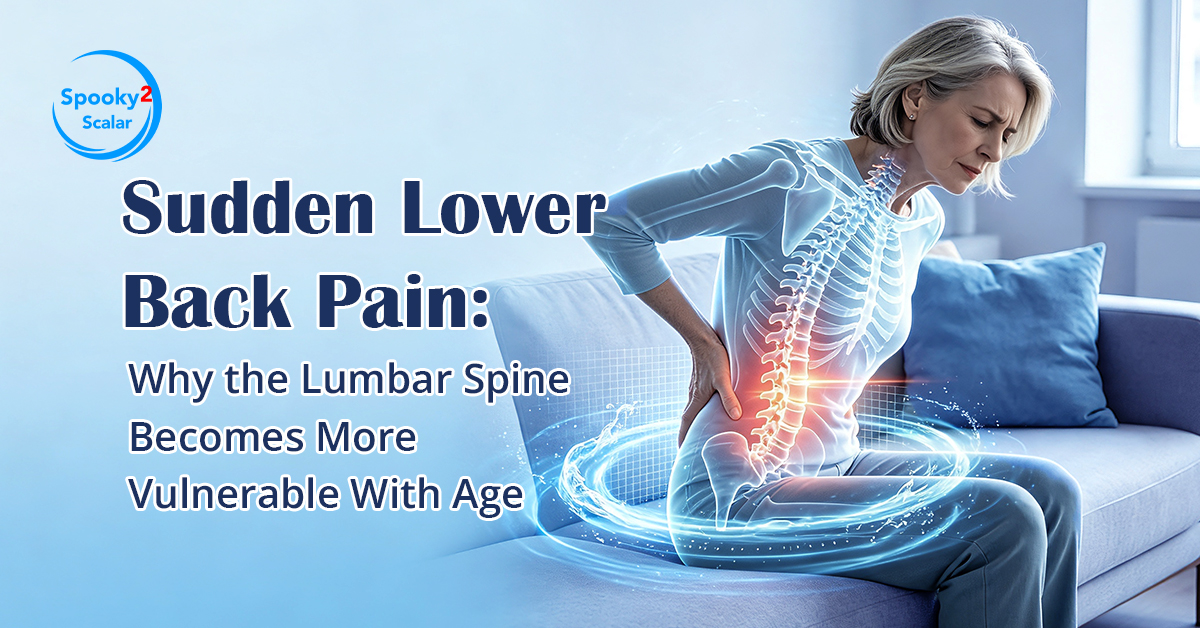
When Back Pain Appears Without Warning
Many people describe this as “throwing out” their back. Although the pain may appear in a single moment, the weakness behind it may have developed gradually.
As we age, the discs, joints, ligaments, and muscles supporting the lumbar spine naturally change. Combined with prolonged sitting, reduced activity, repeated strain, and weaker supporting muscles, these changes can make the lower back less tolerant of sudden movement.
What Happens When You “Throw Out” Your Back?
“Throwing out your back” is not a medical diagnosis. It usually describes sudden lower-back pain after bending, twisting, lifting, reaching, or moving awkwardly.
The pain can feel severe because the muscles around the irritated area may tighten quickly to protect the spine. This guarding response restricts movement, but it can also cause stiffness, spasms, and difficulty standing upright.
Why the Lower Back Becomes More Vulnerable With Age
The lumbar spine supports much of the body’s weight while allowing bending, rotation, and everyday movement. Its stability depends on several structures working together.
Spinal Discs Lose Flexibility
With age, intervertebral discs may gradually lose water, height, and elasticity, reducing their ability to absorb pressure and adapt to sudden strain.
Supporting Muscles Become Weaker
When the abdominal, back, hip, and gluteal muscles weaken, more demand may be placed directly on the lumbar spine during everyday movement.
Joints and Ligaments Become Stiffer
Gradual stiffness can reduce the lower back’s ability to respond comfortably when a movement is unexpected, forceful, or unfamiliar.
Why One Small Movement Can Cause So Much Pain
The movement that triggers the pain is often only the final factor. An activity may simply exceed what the lower back is currently prepared to handle.
What to Do After Sudden Lower Back Pain
Stop the Triggering Movement
Avoid repeatedly testing the painful motion or continuing to lift, twist, or bend through the discomfort.
Return to Gentle Movement
A short period of rest may help, but prolonged bed rest can increase stiffness. Begin walking and changing positions as symptoms allow.
Use Heat or Cold Carefully
Heat may relax tight muscles, while cold may feel soothing shortly after a strain. Avoid forceful stretching during the most painful stage.
⚠️ Seek Urgent Medical Attention When Pain Occurs With:
- Loss of bladder or bowel control
- Numbness around the groin or inner thighs
- New or increasing leg weakness
- Difficulty walking or maintaining balance
- Fever or unexplained weight loss
- Severe pain following a fall or accident
How to Build a More Resilient Lower Back
Age-related changes cannot be completely prevented, but they do not mean the lower back must become fragile.
Strengthen the abdominal muscles, back extensors, hips, and glutes to provide better support for the lumbar spine.
Walk regularly and change positions throughout the day instead of remaining seated or standing for hours.
Keep objects close to the body, use the hips and legs, and avoid twisting while lifting or carrying.
Prioritize sleep, hydration, gentle movement, and sufficient recovery between periods of physical activity.
How Scalar Energy May Support Cellular Recovery
Lower-back recovery depends on the energy and communication of the cells within muscles, connective tissues, and surrounding structures.
Mitochondria produce much of the energy cells need for normal function, maintenance, and tissue repair. As the body ages, mitochondrial efficiency may gradually decline, contributing to lower cellular energy and slower recovery.
Scalar energy is used in wellness practices to create a more balanced energetic environment around the body. It may support cellular communication, energy balance, and the natural coordination of repair processes.

Supporting the Lower Back With Spooky2 Scalar
Spooky2 Scalar can provide more focused support through Rife Scalar mode. When connected to GeneratorX Pro, selected frequency programs can be transmitted through the Scalar field between the Transmitter and Receiver.
Users can search the Spooky2 frequency database for terms such as:
Final Thoughts
Sudden lower-back pain may feel as though it came from nowhere, but the back’s vulnerability often develops gradually.
Age-related changes, weaker supporting muscles, prolonged sitting, repeated strain, and insufficient recovery can all reduce how well the lumbar spine responds to an unexpected movement.
The goal is not to prevent every natural change in the spine. It is to maintain enough strength, mobility, cellular energy, and resilience to continue bending, lifting, walking, and enjoying everyday life.
This article is for general wellness education and is not a substitute for professional medical diagnosis or treatment.
A sudden backpain and muscle weekness can also come from an intestinal problem. If none from the above issues apply, look there !